

Track SEO KPIs Effectively: Boost Your Online Performance Today!. Discover how to track SEO KPIs effectively & elevate your online presence. Boost your performance today with simple tips & strategies!

<<<<< Buy Now from Official offer >>>>>
Why Track SEO KPIs?
Tracking SEO KPIs is essential for website success. These metrics help measure the effectiveness of your online strategies. Without tracking, you cannot tell what is working & what is not. It allows you to adjust your tactics based on real data. Successful businesses use these metrics to stay competitive. They provide insights that help in decision-making. You can pinpoint areas needing improvement. This leads to better optimization & higher rankings. Measuring SEO KPIs also helps in goal setting. You can set realistic targets & assess progress over time. This self-evaluation ensures that you remain focused on your objectives.
Most importantly, tracking helps in resource allocation. You can see where to invest time & money effectively. For example, spending more on strategies yielding high returns makes sense. Evaluating performance helps guide future actions. Therefore, any serious online business should use SEO KPIs effectively.
Key SEO KPIs to Track
Identifying the right KPIs is crucial. They offer insights into different aspects of SEO performance. Here are some essential KPIs to monitor:
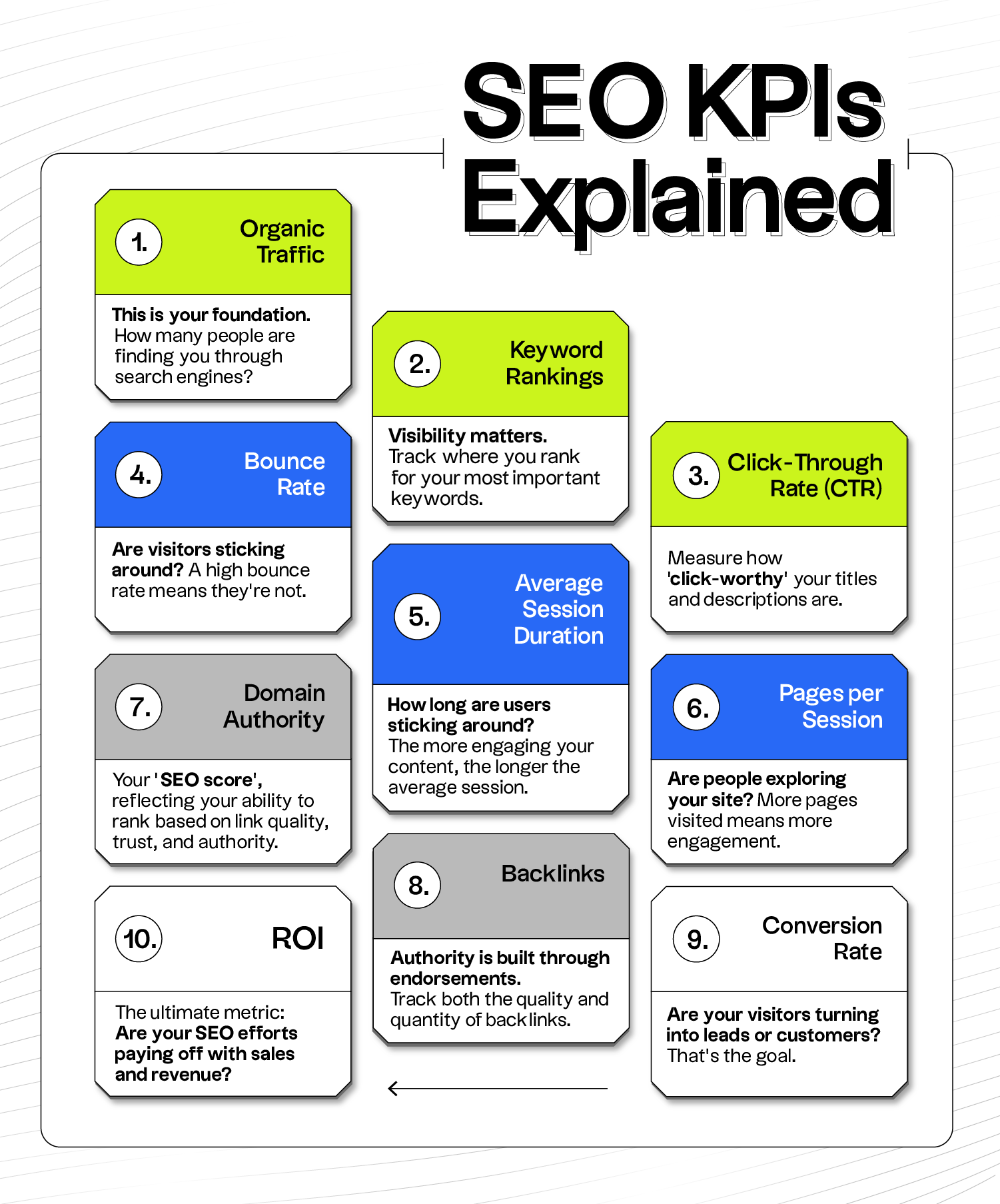
- Organic Traffic: The number of visitors from search engines.
- Bounce Rate: The percentage of visitors leaving after one page.
- Conversion Rate: The percentage of visitors taking a desired action.
- Page Speed: The load time for each page.
- Keyword Rankings: Your position for target keywords.
Tracking these KPIs provides a complete view of your website’s performance. For example, high organic traffic but a high bounce rate indicates poor content relevance. Each metric tells a story, & together, they provide a clearer picture.
How to Measure SEO KPIs
Measuring SEO KPIs requires tools & methodologies. Various tools exist to track these metrics effectively. Google Analytics is one of the most popular. It allows you to measure traffic sources & user behavior.
Another useful tool is Google Search Console. It helps track keyword rankings & provides insights on site health. And another thing, SEMrush & Ahrefs are excellent for keyword tracking. They give detailed reports on position changes & competition.
Set up tracking for your selected KPIs. Define what success looks like for each one. For instance, aim for lower bounce rates or higher conversion rates over time. Start by establishing a baseline for measurement. This could be your current traffic levels or previous performance. From there, set achievable goals & regularly monitor your progress.
Setting Up SEO KPI Goals
Effective goal-setting for SEO KPIs is vital. Start with SMART goals: Specific, Measurable, Attainable, Relevant, & Time-bound. This method ensures clarity in objectives. For example, instead of general goals, aim to increase organic traffic by 20% in six months.
Define what success looks like for each KPI. For organic traffic, determine the current numbers. Then, create a strategy to increase this traffic. Use historical data to set realistic benchmarks. This allows you to track progress accurately. Having a clear target keeps the team focused & motivated.
Ensure your goals align with overall business objectives. For instance, if the main goal is to increase sales, focus on conversion rates. Tracking KPIs should lead to actionable insights & improve outcomes. Regularly revisit & adjust goals as needed.
Using Data to Enhance Performance
Data from SEO KPIs can guide decisions. Regularly analyze your metrics to identify trends. For instance, tracking keyword rankings can reveal new opportunities. If a keyword rises, it may indicate growing interest.
Here’s how to use data for performance enhancements:
| Action | Data Source |
|---|---|
| Identify High-Performing Content | Google Analytics |
| Investigate Bounce Rate Causes | Google Analytics |
| Track Keyword Changes | SEMrush |
| Monitor Backlink Profile | Ahrefs |
Use this data to refine your strategies. If certain content performs well, create more similar content. Track pages with high bounce rates & assess why visitors leave. This evaluation can lead to modifications that enhance engagement.
Regular Reporting on SEO KPIs
Regular reporting is essential for tracking SEO KPIs effectively. Create a schedule for reviewing your performance data. Weekly or monthly reports can help track progress. Share these reports with relevant stakeholders.
Reports should include a summary of key metrics. Highlight successes & areas for improvement. Use visuals aids like charts & graphs for clarity.
Here’s an example of key sections to include in your reports:
- Current organic traffic levels
- Keyword ranking changes
- Conversion rates
- Bounce rate statistics
- Content performance breakdown
This structure ensures everyone stays on the same page & allows for informed decision-making. Tracking progress ensures adjustments can be made timely.
Tools for Tracking SEO KPIs Efficiently
Many tools can help track your SEO KPIs efficiently. Each tool offers unique functionalities & metrics. Here are some noteworthy options:
| Tool | Primary Function |
|---|---|
| Google Analytics | Traffic analysis & user behavior |
| Google Search Console | Keyword performance & site health |
| SEMrush | Keyword tracking & competition analysis |
| Ahrefs | Backlink monitoring & keyword research |
Selecting the right tools depends on your needs. For example, Google Analytics excels at measuring user behavior. Meanwhile, Ahrefs offers in-depth backlink analysis. Combining various tools can provide a comprehensive picture of performance. This integration increases the potential for better decision-making.
Interpreting SEO KPI Data Correctly
Interpreting SEO KPI data is crucial for effective tracking. Data without context can lead to poor decisions. Understand the meaning behind your numbers.
For instance, high organic traffic might seem beneficial. Be that as it may, if conversion rates are low, deeper analysis is needed. Investigate why visitors do not convert. Factors like poor user experience or content can affect this.
Look for patterns over time. Consistent high bounce rates may indicate content is misaligned with user intent. Constantly reassess your findings. Ensure adjustments are based on the most current & accurate data.
Use benchmarks to compare performance. Regularly checking against industry standards provides context. This helps determine if you are meeting expectations or need improvements.
Best Practices for Tracking SEO KPIs
To track SEO KPIs effectively, follow best practices. Be organized in your approach. Set consistent tracking intervals for analysis.
Build a dashboard using your chosen tools. Streamlining data helps with easy access to metrics. Focus on a few key performance indicators instead of trying to measure everything at once.
Include qualitative feedback to supplement quantitative data. Use surveys or user feedback to get insights into user experience. This can add more context to numeric metrics.
Lastly, always aim to learn & adapt. SEO trends change frequently. Be prepared to shift your strategies based on insights. Regular review sessions with your team can foster collaboration.
“Track SEO KPIs Effectively: Boost Your Online Performance Today!” – Catharine Gibson
Case Study: Successful KPI Tracking
Successful case studies can offer valuable lessons. One company focused on improving organic traffic using SEO KPIs.
First, they established their baseline metrics. They analyzed traffic sources & identified top-performing content. Next, they set a goal to increase organic traffic by 30% within six months.
They implemented targeted keyword strategies. The team regularly monitored their progress. Changes were made based on performance data. In the end, they not only met their goal but exceeded it.
This case illustrates the power of effective KPI tracking. A data-driven approach led to tangible results. You, too, can see gains through consistent analysis & adjustment.
Evaluating Trends in Your SEO KPIs
Finally, evaluating trends in your SEO KPIs helps inform strategy. Regularly reviewing trends makes it easier to spot changes over time. Track variations in traffic, rankings, & conversions.
Utilize visual tools to display trends clearly. Graphs showing monthly traffic or rank improvements can highlight successes. Identify consistent patterns for opportunity recognition.
Continually adapt your strategies based on findings. For example, if a specific content type consistently performs well, increase focus on that style. Stay engaged with industry changes, as they can influence trends.
Stay proactive about your SEO efforts. A keen eye on KPIs ensures you keep track of evolving online performance. Your business can improve consistently with regular adjustment & focus.
<<<<< Buy Now from Official offer >>>>>
Feature of Squirrly SEO
Squirrly SEO offers an array of features that cater to both beginners & seasoned marketers. As a comprehensive SEO tool, it focuses on Track SEO KPIs Effectively: Boost Your Online Performance Today! with several unique functionalities.
Users gain lifetime access to Squirrly SEO, including all future Business Plan updates. If there are any name changes to plans, users will seamlessly transition to the new plan name along with all corresponding updates. A notable feature is the ability to redeem codes within 60 days of purchase, which allows stacking up to 10 codes. Squirrly is also GDPR compliant, ensuring adherence to European data protection laws.
This tool is available for new users & returning AppSumo As well as purchasers. Those who previously purchased Squirrly SEO can buy additional codes to increase their limits. Notably, prior AppSumo customers will retain benefits from new features & limits. Essential features include:
- Top-ranking pages leaderboard
- Unlimited page content marketing analytics
- Unlimited content optimizations with SEO live assistant
- Unlimited Google rank checks using Google Search Console
- Pro SEO live assistant
- Copyright-free images for blogs
- Blogging assistant, auditing features, & duplication detection
- Business SERP checker
- Keyword tracking capabilities
Challenges of Squirrly SEO
While Squirrly SEO provides numerous benefits, users often encounter challenges. Features could have limitations, particularly in areas such as keyword suggestions & advanced analytics. Some users find the learning curve steep for maximizing the tool’s potential. Feedback from users suggests a need for enhanced tutorials & user support.
Compatibility issues with different WordPress themes & plugins sometimes arise, leading to frustration among users. And another thing, there may be limitations in customer support response times, especially during high-demand periods. Solutions to these challenges can include utilizing community forums & seeking guidance from more experienced users.
To overcome these hurdles, users can explore the extensive knowledge base provided by Squirrly. Engaging in training sessions can also help boost user confidence & effectiveness in using the platform. Collaboration with others in industry forums may further enhance the learning experience.
Price of Squirrly SEO
Squirrly SEO offers several pricing plans to accommodate various user needs. The structure provides flexibility based on the features required. Here’s an overview:
| Plan | Price |
|---|---|
| Single | $99 |
| Double | $198 |
| Multiple | $297 |
This tiered pricing structure allows users to choose plans that best meet their budget & requirements. Regular updates & improvements are included with all plans.
Limitations of Squirrly SEO
Despite its robust features, Squirrly SEO has limitations. It may lack advanced customization options compared to competitors. Some users express disappointment over the absence of comprehensive backlink tracking tools. And another thing, the SEO dashboard interface could benefit from simplification for easier navigation.
User experience may not be consistent across different segments of the tool. In particular, content analysis results can sometimes feel generic. Suggestions for improvements include refined algorithms for content optimization. Users have also noted the need for more advanced reporting features, especially for larger teams managing multiple projects.
Case Studies
Numerous case studies showcase the effectiveness of Squirrly SEO in real-life scenarios. One case involved a small business adjusting its content strategy based on insights from Squirrly. After implementing recommendations, organic traffic increased by over 70% within three months.
Another example highlights a digital marketing agency that utilized Squirrly’s analytics to reshape client SEO strategies. By tracking keyword rankings effectively, they improved their clients’ online visibility significantly, leading to higher conversion rates.
A non-profit organization benefited through enhanced blog posts, optimizing existing content, & identifying new keyword opportunities. This resulted in increased engagement & donations, demonstrating Squirrly’s potential across various sectors.
Recommendations for Squirrly SEO
Maximizing the benefits of Squirrly SEO involves several actionable strategies. First, users should dedicate time to understand the tool’s extensive features through video tutorials & guides available on the platform.
Conduct regular audits of your content using Squirrly’s built-in tools. This will help identify areas for improvement & eliminate duplicated content. Focus on setting specific KPIs related to your SEO goals, utilizing Squirrly’s analytics for better insights.
Lastly, consider integrating Squirrly with other tools for enhanced functionality. For example, combining with social media management tools can streamline outreach efforts. And another thing, pairing with email marketing platforms can enhance content distribution strategies.
Additional Insights on SEO KPIs
Sustaining a successful SEO strategy requires ongoing attention to key performance indicators (KPIs). Specific metrics are critical in assessing performance & guiding decision-making. Consistent attention to these elements can increase website visibility & engagement.
- Organic search traffic growth
- Keyword ranking improvements
- Click-through rate (CTR) on search engine results pages
- Bounce rate metrics
- Average session duration
- Number of pages viewed per session
- User engagement on content
Effective Strategies to Track SEO KPIs
Implementing effective tracking strategies is vital for monitoring SEO progress. Utilize Google Analytics to gain valuable insights into user behavior. Set up specific goals within Google Analytics to measure conversions accurately.
Employ SEO tools, including Squirrly, for ongoing ranking checks. Tracking keyword performance helps understand the effectiveness of content optimization efforts. Regularly reviewing reports generated can provide actionable insights for continuous improvement.
Adopting dashboards can visually represent KPIs, making it easier to monitor trends over time. Focusing on a targeted strategy will enhance not only traffic but overall website performance.
Conclusion on Performance Optimization
Effective Track SEO KPIs Effectively: Boost Your Online Performance Today! involves collaborative efforts & strategic planning. Understanding Squirrly SEO’s features can lead to optimal results. Identifying limitations can allow for educated decisions on tools to complement your strategy.
Empowering your SEO initiatives requires commitment & regular adaptation to changes in search engine algorithms. With time & effort, significant online performance improvements can be achieved.
What are SEO KPIs?
SEO KPIs are metrics used to measure the effectiveness of SEO strategies. They can include organic traffic, keyword rankings, conversion rates, & bounce rates.
Why are KPIs important for SEO?
KPIs provide insights into how well your website is performing in search engine rankings & user engagement, allowing for informed decisions to improve online presence.
What are some common SEO KPIs to track?
Common SEO KPIs include organic search traffic, return on investment (ROI), keyword position, click-through rate (CTR), & website load time.
How can I track my SEO KPIs?
You can track SEO KPIs using tools like Google Analytics, Google Search Console, & various SEO software platforms that provide insights & reporting features.
What tools are recommended for tracking SEO KPIs?
Recommended tools include Google Analytics, SEMrush, Ahrefs, Moz, & Screaming Frog, each offering unique features for monitoring SEO performance.
How often should I review my SEO KPIs?
It is advisable to review your SEO KPIs regularly, ideally on a monthly basis, to effectively gauge the performance of your strategies & make necessary adjustments.
Can SEO KPIs impact my content strategy?
Yes, SEO KPIs can significantly influence your content strategy by identifying which topics perform well & where adjustments might be needed to enhance engagement & visibility.
What is the relationship between SEO KPIs & user experience?
SEO KPIs often reflect user experience. Metrics such as bounce rate & time on site provide insights into how users interact with your content, guiding improvements to enhance satisfaction.
How do I set realistic SEO KPI targets?
Setting realistic SEO KPI targets involves analyzing historical data, industry benchmarks, & understanding your current performance to create achievable goals over time.
What should I do if my SEO KPIs are declining?
If your SEO KPIs are declining, consider conducting a thorough analysis of your website, evaluating content quality, backlinks, & changes in search algorithms to identify areas for improvement.
Are SEO KPIs the same for every business?
SEO KPIs may vary by industry & business goals, so it’s essential to align your KPIs with your specific objectives to measure success accurately.
What role do backlinks play in SEO KPI tracking?
Backlinks are a crucial factor in SEO performance, with their quantity & quality impacting search rankings. Tracking the number & relevance of backlinks can help monitor SEO effectiveness.
How can I improve my keyword ranking SEO KPI?
Improving keyword rankings involves optimizing your content with relevant keywords, enhancing page load speeds, & ensuring quality backlinks while consistently updating your content.
<<<<< Buy Now from Official offer >>>>>
Conclusion
To truly succeed online, it’s crucial to Track SEO KPIs Effectively. By keeping an eye on key performance indicators, you can understand what’s working & what isn’t. Remember, tracking isn’t a one-time task; it’s an ongoing process that helps you adjust strategies for better results. The insights you gather will not only help you improve your content but also boost your website’s visibility. So, start today! Make the effort to boost your online performance & watch your efforts pay off. Your website deserves to shine, & tracking SEO KPIs is the way to achieve that.
<<<<< Buy Now from Official offer >>>>>
Leave a Reply
You must be logged in to post a comment.